Running isn't just exercise, it's identity. We find what's actually breaking down and build a plan that gets you back to mileage instead of just resting through it.
For half-marathoners, first-timers, and lifelong runners.
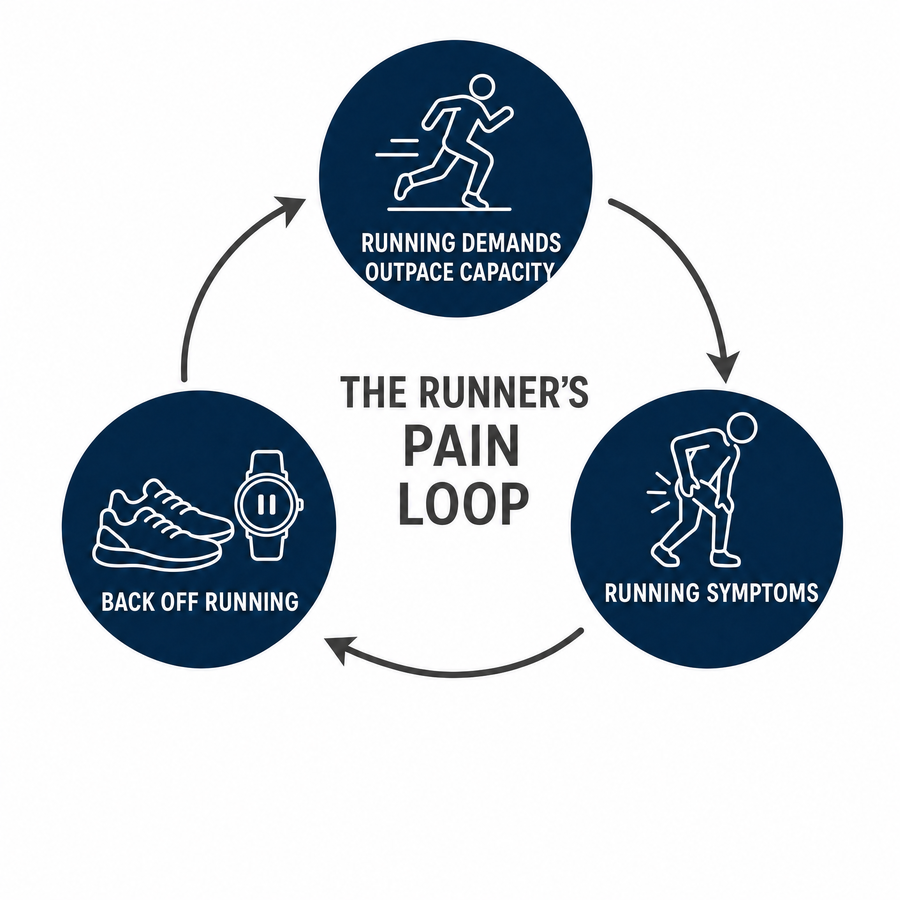
Nearly half of everyone who calls us is a runner. This is the cycle almost all of them describe.
“Every time I try to increase my mileage, something goes wrong.”
The ceiling you keep hitting“I've dealt with this before and it went away, but now I'm back.”
Nothing stays fixed“I'm scared I won't finish my race because of this.”
The date that isn't movingA printout of your stride is a measurement. It's not a plan. We look head to toe, not just where it hurts, and pair that with your training load and history to explain exactly what's driving the breakdown.
We test the tissue that's actually failing and how you're loading it, not just glance at your form.
Knee pain is rarely a knee problem. We check the hip, ankle, and mileage pattern that's overloading it.
Racing in six weeks or just trying to run consistently again, your plan is built around that goal.
You don't need to self-diagnose before you call. This just helps you see we've treated exactly this before.
Sudden or building pain at the front or outside of the knee that shows up during training and won't fully settle, even with rest. Often shows up right as mileage increases for a race. We identify the mechanical cause (hip weakness, load pattern, footwear, or all three) and build you back up without the flare-up returning.
Shin splints, plantar fasciitis, or ankle instability that has come and gone before and is now back. This pattern almost always means the underlying driver was never actually resolved, just quieted down. We find that driver so it stops recurring.
Achilles pain or stiffness that's worst first thing in the morning or right after a run, often with calf tightness that never fully releases. This is one of the injuries most likely to get you told to just stop running. We find what's actually overloading the tendon and build a plan that keeps you training while it heals.
Hip flexor tightness, glute weakness, SI joint irritation, or low back soreness that shows up as mileage climbs, especially heading into a marathon or triathlon. This is rarely just a hip or back problem, it's usually a strength and load issue further down the chain. We find it and fix it before it costs you a long run.
No injury yet, just a nagging feeling that something in your form is a little off, or a desire for an outside, expert set of eyes before you build toward a goal race. This is an assessment and partnership, not a treatment plan for pain.
Rest alone almost never fixes a running injury. It just pauses the symptom until you go back to training and the same weakness overloads again. Here's how we actually break that cycle.
“Chris was awesome! Got me back up and running in just a couple sessions, after fighting injury for over 3 months! Only regret is I didn't do it sooner.”
Yes, running injuries are one of our most common cases. We don't just treat the pain, we analyze your movement pattern, find the root cause, and build a plan that keeps you running rather than telling you to rest. "I was told to just stop running. That wasn't an option for me. They actually figured out why it was happening and fixed it." VTP Patient
Usually not entirely. We'll tell you honestly if a short break is needed, but the goal is almost always to modify your training, not eliminate it, while we fix the underlying issue.
A gait video shows you a measurement. It doesn't explain why your body is moving that way or fix it. We combine the running assessment with a full evaluation and a doctor of physical therapy who actually changes your mechanics over time.
No. Oklahoma allows direct access to physical therapy, so you can schedule with us without a physician referral. Many running injuries can be accurately assessed without imaging, and we'll let you know if imaging is warranted after your evaluation.
Rarely. Recurring running injuries usually persist because the root cause was never identified, just rested until quiet. A thorough evaluation can often uncover what was missed.
A short, low-pressure first conversation. Tell us about your training, your race, and what keeps interrupting it, and we'll help you figure out the next step.